Putting Our Knowledge and Experience to Work in Practice
We help organizations manage their knowledge so they can focus on their core business.
We leverage our knowledge and experience in analyzing, modeling, and ensuring compliance to help organizations demonstrate compliance, operate more efficiently, and respond more quickly to changes.
Advancing digitalization means that business goals, more than ever, are guiding new IT solutions.
PNA offers a results-oriented and integrated approach to decision-making regarding digitization issues. We analyze the relevant laws and regulations, business processes, as well as business rules, data definitions, and decisions, and ensure alignment between your objectives, the necessary information, and the various systems.
As a result, you will be better able to identify bottlenecks and opportunities within your organization more quickly and, based on that, develop the right solutions.
In addition to our specific products and solutions, we also offer more general consulting services in the areas of knowledge analysis and modeling, Legal analysis, data management, and model implementation.
Knowledge analysis
Knowledge is everywhere: in formal and informal documents, systems, and databases, and in people’s minds. Knowledge is generated by people, but in recent years, of course, increasingly by algorithms as well. Knowledge is crucial for decision-making and, therefore, for the optimal functioning of your processes.
We are able to make all knowledge relevant to your organization visible and traceable. The cogNIAM® method guarantees the completeness and traceability of the captured knowledge. Our analysts are the world’s most experienced experts in analysis based on Fact-Based Modeling, BPMN 2.0/SBVR, and DMN. Using cogNIAM®, potentially supported by our knowledge tools, you will be able to increase the value of your knowledge capital.
Knowledge Modeling
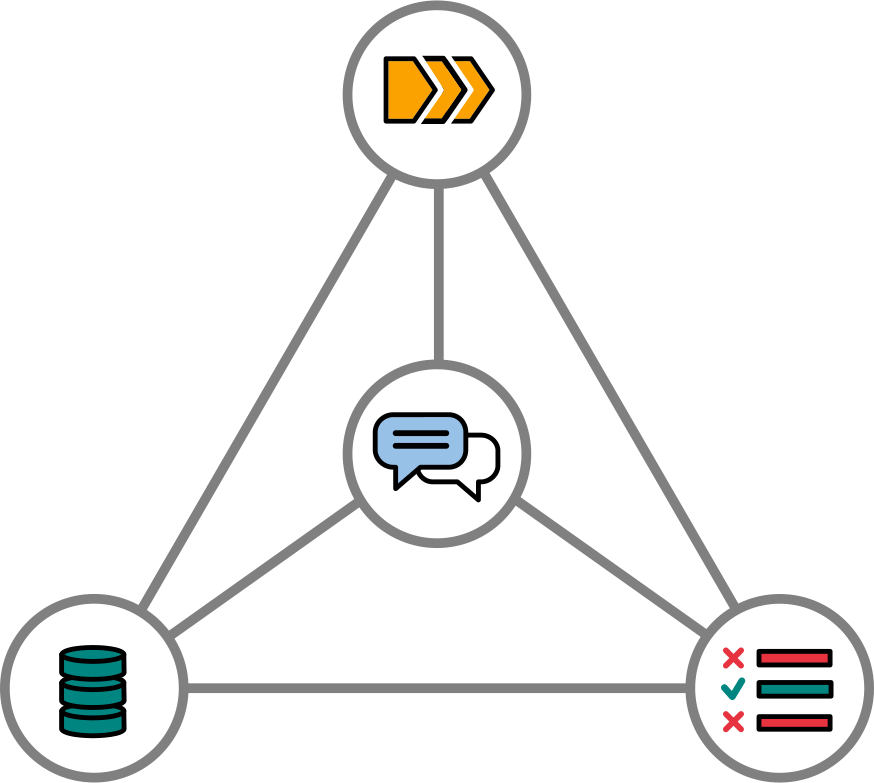
PNA reveals the connections between your organization’s processes, rules, data, and semantics. To this end, we have developed the “knowledge molecule,” which is fully integrated into cogNIAM®. In this way, we model not only data and information, but also their meaning and the context in which they are used. Models can then be used in no-code/low-code platforms without human intervention. This brings truly model-based software within reach, offering the advantage of higher quality at substantially lower costs.
Legal analysis
Laws and regulations are crucial to the functioning of your organization. To ensure that you comply with laws and regulations—and continue to do so—we have developed, in collaboration with our clients, an approach that has proven effective in practice. This approach translates laws and regulations into (digital) implementation. This approach, supported by our knowledge tools, ensures that laws and regulations always align with implementation practices—in other words, “compliance inside.”
Our analysts are happy to assist you not only with implementing the approach, but also with the analysis itself.
Data Management
You want to be able to make decisions based on data: it must be reliable, correctable, and accessible. However, data flows—both incoming and outgoing—have grown explosively and exponentially in recent years. To cope with that growth, data management is crucial. In our approach, based on DMBOK2, data management is, so to speak, built right in—if only because we place such great value on the significance of data. Information about customers, for example, may well be stored in multiple systems, but it can also be used in very different ways by various departments or employees within a company. It is therefore important to be able to rely on the same definitions in order to generate meaningful reports.
Model implementation
Our collaboration with PNA doesn’t have to end once we’ve developed a knowledge model together with you. We can also support you in designing and implementing the information systems based on your knowledge models. Because these models are so rich, we’re able to generate many system components. However, additional design and programming work will often be required. Our focus in this process is on functionality, architecture, investments, and risks—naturally, using an Agile approach. We guide you through acceptance testing, implementation, and evaluation of the system.