Over the past decades, PNA has published a series of leading books and articles on knowledge modeling, information analysis and the modern knowledge economy. The publications make complex topics clear and directly applicable to both professionals and students. Below is an overview of all books published by PNA, each with a brief description of the content.
Our Publications
Knowledge Based Working
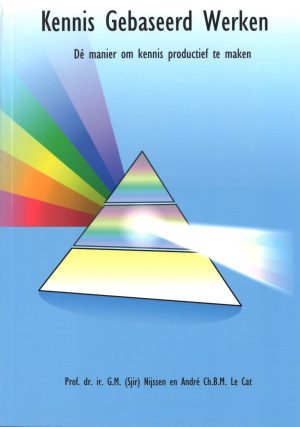
This book introduces Knowledge Based Work as an essential skill for professionals in the modern knowledge economy. It shows how organizations can work smarter by structuring and applying knowledge using international standards such as BPMN, SBVR and the CogNIAM methodology. The authors show how KGW will become a new, generic skill alongside reading, writing and math, and how it helps organizations function consistently, transparently and efficiently. The book also highlights that it is the first worldwide to effectively combine these open standards.
Flexible working conditions
This book shows how organizations can implement more flexible working conditions through clear communication, a proven roadmap and a project-based approach. It emphasizes that seamless interfacing with payroll and workforce management systems is essential for success, especially as laws and regulations surrounding flexibilities change rapidly. Classic automation approaches often fall short, necessitating a generic and sustainable approach. The authors present a systematically developed approach that helps organizations effectively implement and maintain flexible working conditions.
Universal Information Science
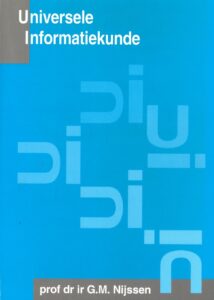
This book describes the essential knowledge and skills of Universal Information Science, a technology-independent approach to analyzing and designing information systems. It combines the precision of mathematics and logic with the comprehensibility of plain language, describing complex information systems in a clear and verifiable way. Intended as a textbook for both college and university students, it provides a communicative and human-centered alternative to traditional information techniques. The book shows how universal principles, enshrined in five axioms, can be applied to develop effective and quality-oriented information systems.
Information Analysis and Database Design
This book explains the principles and methods of NIAM, a fully natural language-based method for information analysis and database design. It emphasizes that effective handling of information is increasingly important in an information-centric era, and therefore provides a clear and accessible approach for scholars, students and professionals. Math Language describes a unified, technology-independent architecture for information systems, making it a solid foundation for further computer science education. The method is laid out without limitations, making the book not only suitable for teaching, but also directly applicable in organizations and practice.
Epistemology 1A
This book introduces Knowledge Literacy as a new, essential generic skill for professionals in today’s knowledge economy. It shows how Knowledge Literacy joins the classic basic skills of reading, writing and arithmetic but adds a modern dimension to them: the ability to quickly learn new knowledge, understand structured information and work with it. The author describes Knowledge Literacy as an integrated combination of language, logic and mathematical thinking that is directly applicable in knowledge-intensive organizations. The book thus provides a foundation for anyone who wants to learn and work effectively in an increasingly complex information society.
Ongoing developments and advances in Legal analysis
In 2021 verscheen het boek Wetsanalyse voor een werkbare uitvoering van wetgeving met ICT van Anouschka Ausems, Mariëtte Lokin en John Bulles (hierna: Wetsanalyse 2021). Dit markeerde een belangrijke stap in de ontwikkeling van Wetsanalyse, waarbij de toenmalige kennis is vastgelegd. Inmiddels wordt Wetsanalyse onderwezen aan universiteiten en hogescholen en bieden ook andere opleiders, zoals de Open Universiteit en PNA, regelmatig workshops en cursussen aan over Wetsanalyse en Wendbare Wetsuitvoering.
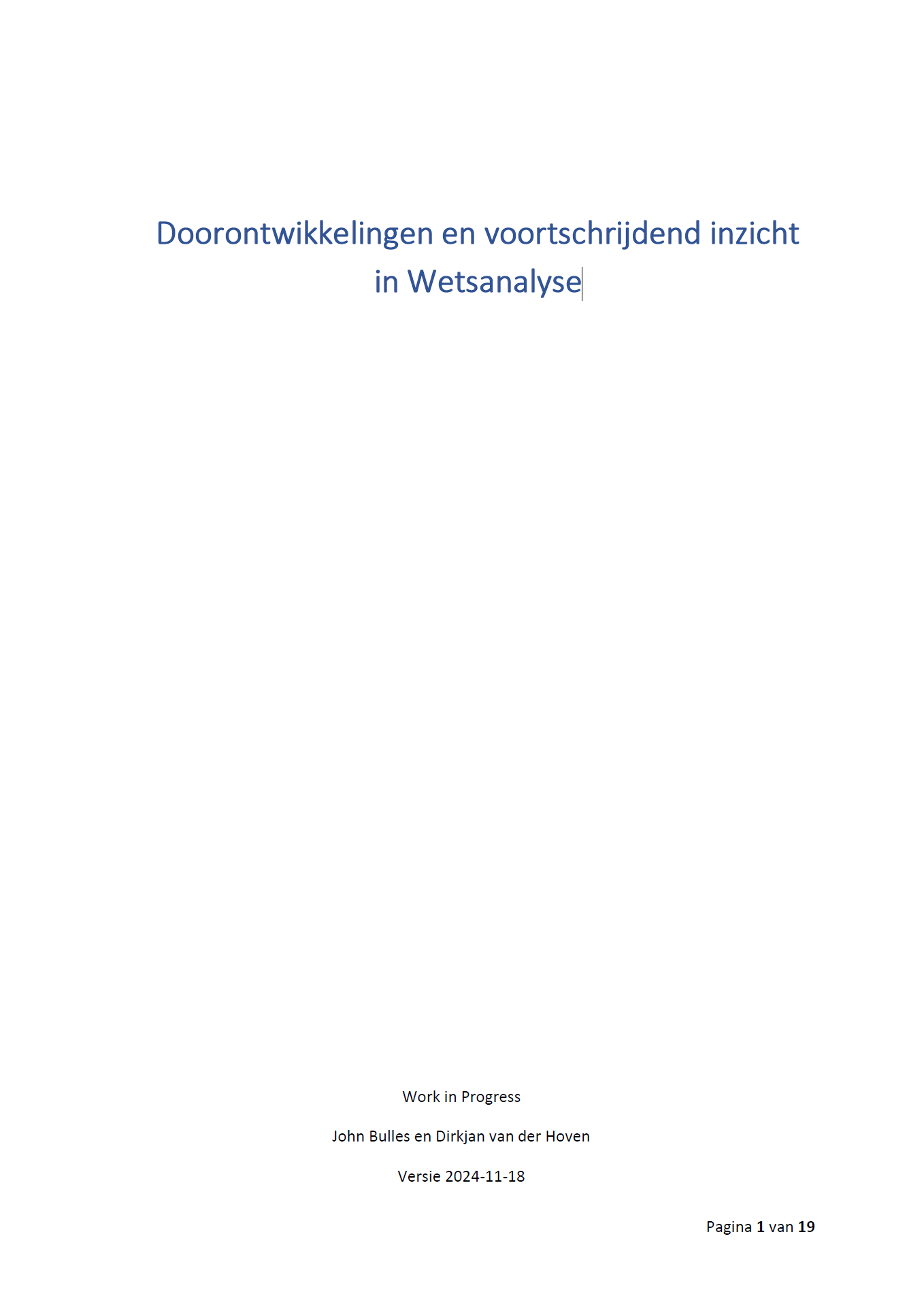
In de periode daarna is gehoor gegeven aan de oproep in Wetsanalyse 2021 om Wetsanalyse verder te ontwikkelen op basis van praktijkervaringen en nieuwe inzichten. Wetsanalyse is in diverse praktijktoepassingen getest en doorontwikkeld. De belangrijkste conclusies en inzichten uit deze toepassingen vormen de kern van dit document. De beschreven doorontwikkeling sluit aan bij de voortdurende innovatie van Wetsanalyse en is mede gebaseerd op het werk van prof. dr. Sjir Nijssen in de afgelopen jaren.
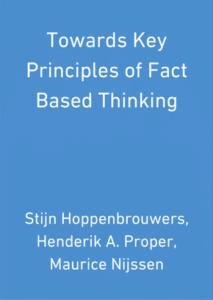
Abstract. In this paper, we present ten principles that, in our view, underlie and define the practice and science of ‘Fact Based Thinking’. In itself, Fact Based Thinking underpins Fact Based Modelling (FBM) in all its forms. FBM has been around for decades, and has brought forth a number of meta-models and formalizations. The principles as discussed in this paper focus on Fact Based Thinking rather than on matters of representation and precise Semantics, which have been elaborately discussed elsewhere. The principles presented are deliberately worded for broad use and inspirational purposes, rather than worked out in detail. As such, this paper suggests the initialization of further work rather than presenting a final result. The sketch of the principles presented aims to express the basics of Fact Based Thinking in a way that most members of the FBM community can feel at home with.
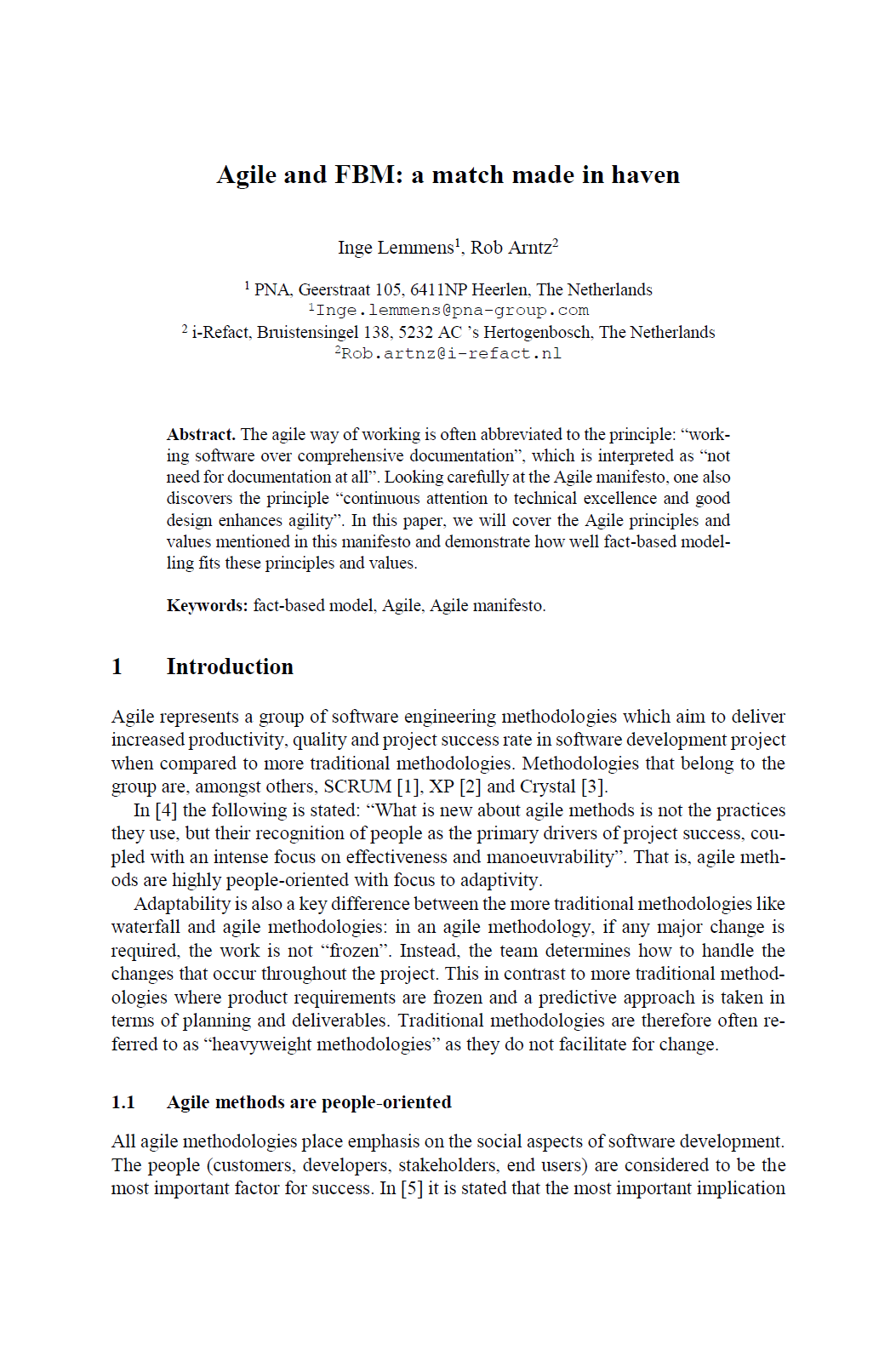
Abstract. The agile way of working is often abbreviated to the principle: “working software over comprehensive documentation”, which is interpreted as “not need for documentation at all”. Looking carefully at the Agile manifesto, one also discovers the principle “continuous attention to technical excellence and good design enhances agility”. In this paper, we will cover the Agile principles and values mentioned in this manifesto and demonstrate how well fact-based modeling fits these principles and values.
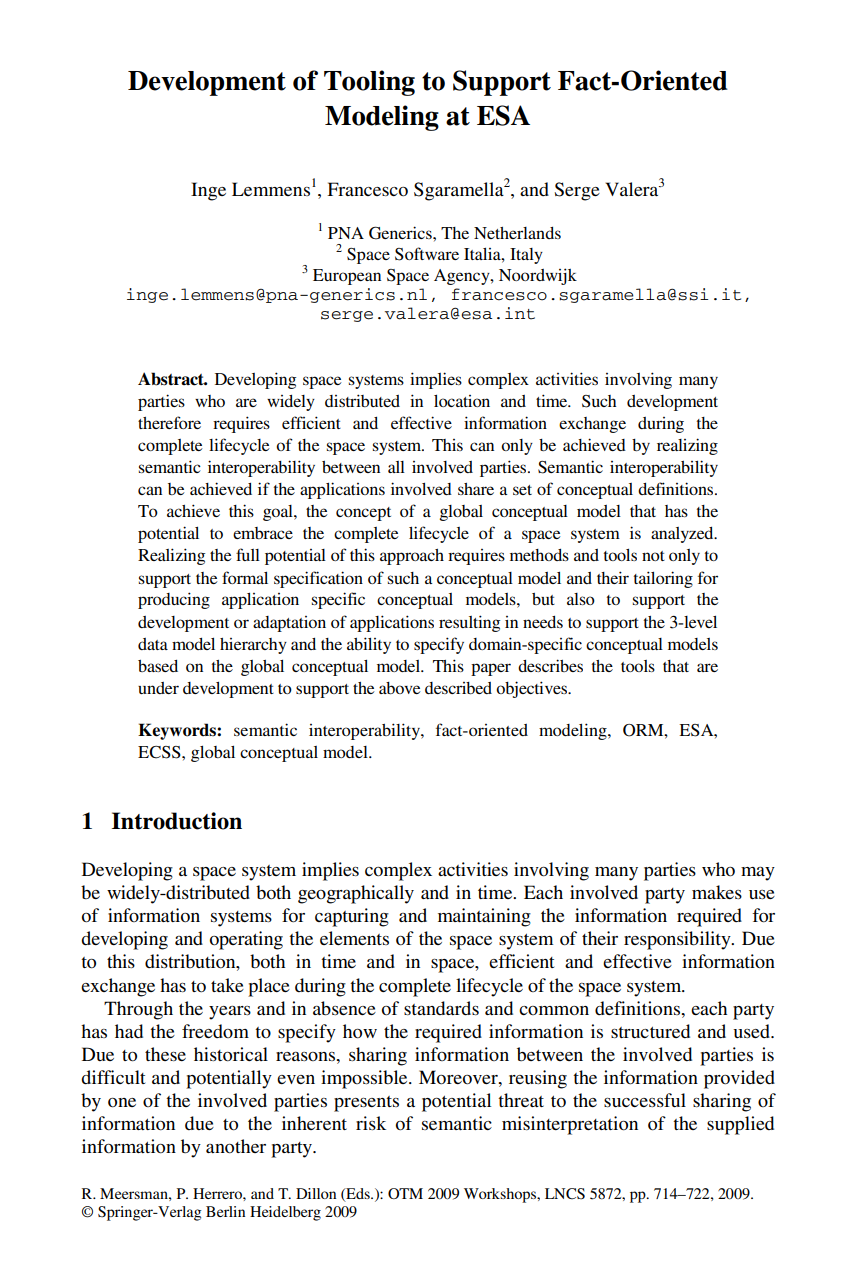
Development of Tooling to Support Fact-Oriented Modeling at ESA
Abstract. Developing space systems implies complex activities involving many parties who are widely distributed in location and time. Such development therefore requires efficient and effective information exchange during the complete lifecycle of the space system. This can only be achieved by realizing semantics interoperability between all involved parties. Semantics interoperability can be achieved if the applications involved share a set of conceptual definitions. To achieve this goal, the concept of a global conceptual model that has the potential to embrace the complete lifecycle of a space system is analyzed. Realizing the full potential of this approach requires methods and tools not only to support the formal specification of such a conceptual model and their tailoring for producing application-specific conceptual models, but also to support the development or adaptation of applications resulting in needs to support the 3-level data model hierarchy and the ability to specify domain-specific conceptual models based on the global conceptual model. This paper describes the tools that are under development to support the above described objectives.
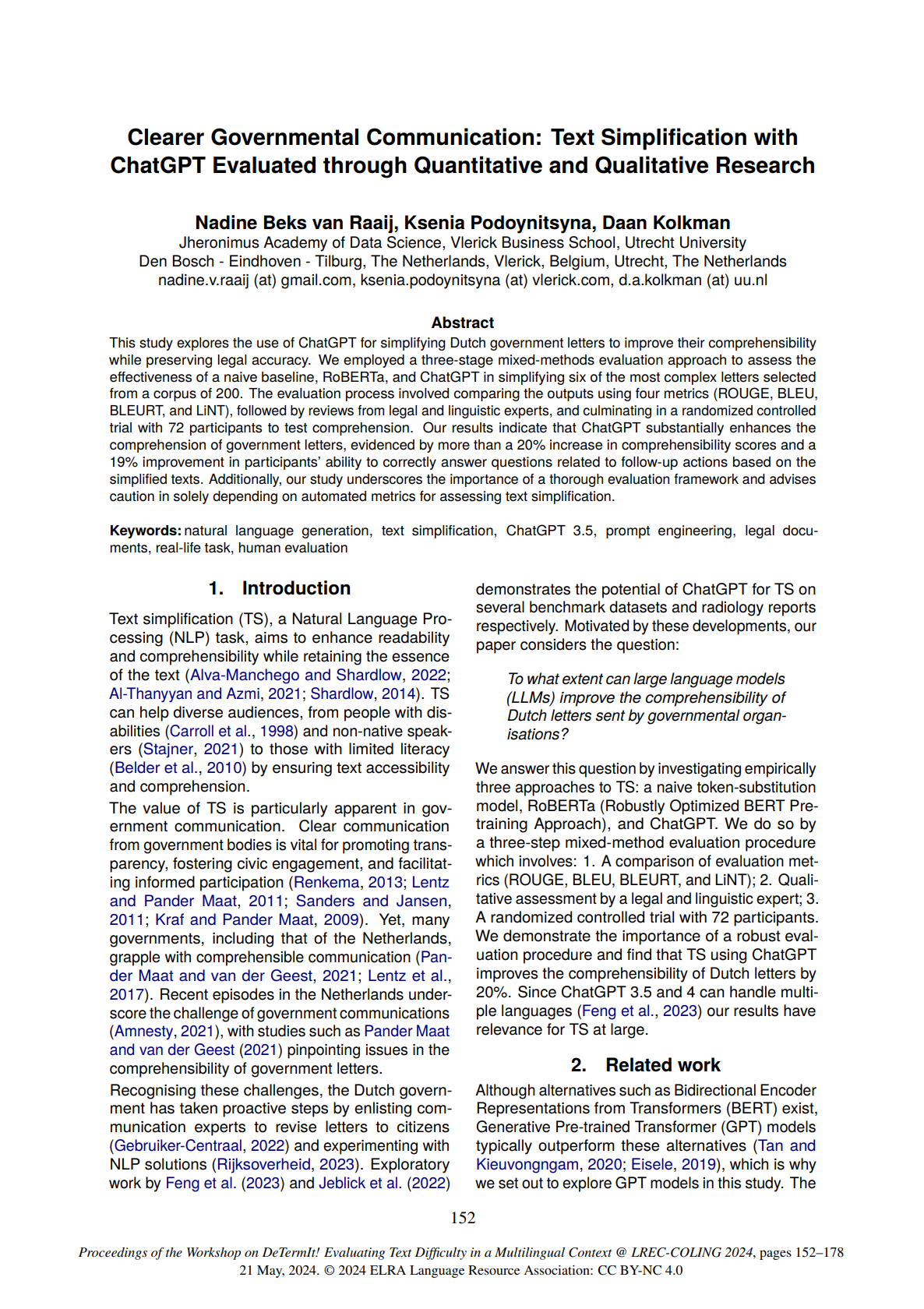
Clearer Governmental Communication: Text Simplification with ChatGPT Evaluated through Quantitative and Qualitative Research
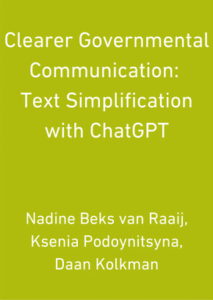
Abstract. This research investigates the application of ChatGPT for the simplification of Dutch government letters, aiming to enhance their comprehensibility without compromising legal accuracy. We use a three-stage mixed method evaluation procedure to compare the performance of a naive approach, RoBERTA, and ChatGPT. We select the six most complicated letters from a corpus of 200 letters and use the three approaches to simplify them. First, we compare their scores on four evaluation metrics (ROUGE, BLEU, BLEURT, and LiNT), then we assess the simplifications with a legal and linguistic expert. Finally we investigate the performance of ChatGPT in a randomized controlled trial with 72 participants. Our findings reveal that ChatGPT significantly improves the readability of government letters, demonstrating over a 20% increase in comprehensibility scores and a 19% increase in correct question answering among participants. We also demonstrate the importance of a robust evaluation procedure.