
CogNIAM®
Our method for knowledge modeling
CogNIAM® is our method for knowledge modeling. The method helps organizations to explicitly define and model concepts, facts, rules and processes in conjunction with each other so that business, IT and information systems use the same meaning and interpretation . The strength of CogNIAM® lies in modeling these four aspects of knowledge together, rather than approaching them as separate silos. CogNIAM also forms the basis for Legal analysis.


Why knowledge modeling
If an organization does not record knowledge or does not record it unambiguously, misunderstandings inevitably arise. If the sales manager considers a “prospect” a “customer,” while “customers” to the accountant are only parties with whom an agreement has been made … This confusion may eventually seep into the information systems, with dire consequences.
CogNIAM integrates all aspects of business knowledge: processes, rules, semantics and data. To emphasize the interrelationship and dependencies between these knowledge elements, we refer to them as a knowledge molecule.
Knowledge molecule
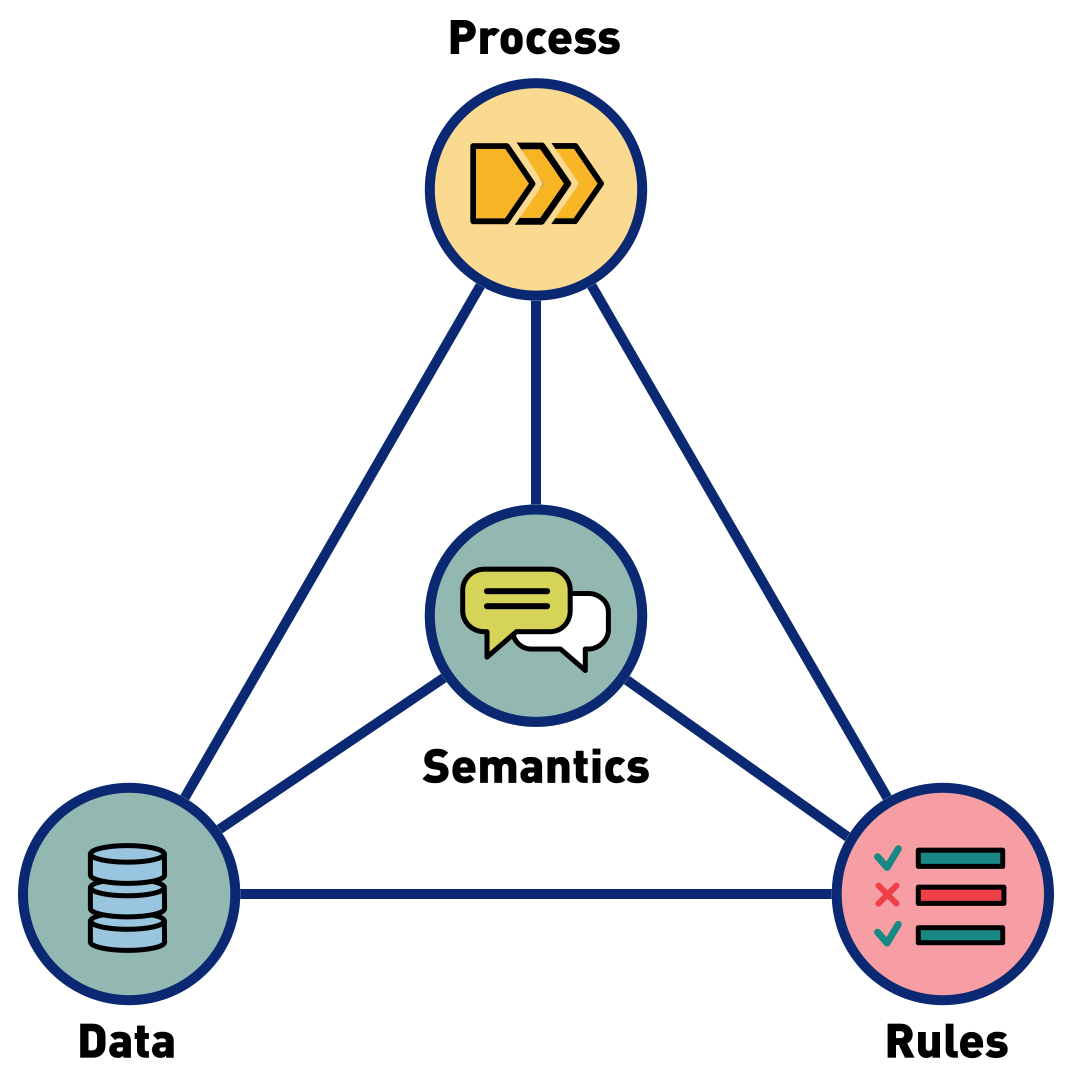
Semantics is the art of assigning and recognizing meaning. Crucial in knowledge and data management, yet often neglected. If for the sales manager, a prospect turns out to be a customer, while the accountant only sees parties as customers with whom a contract has been concluded, this can be a crucial misunderstanding.
In cogNIAM® we do more than just draw up a list of terms: we also structure it by connecting concepts. We place high demands on concept definitions. We use strict criteria for concept definitions to ensure that they are unambiguous.
Semantics in data, rules in processes
We link all concepts to data, rules and processes. In this way, the meaning is always accessible and we can guarantee that everyone in the organization can know in any situation exactly what a particular term means in a specific context.
We live in a knowledge economy built on data. Data without context, however, has no value. To assign and retain that value, you need to properly structure data and provide it with context. With cogNIAM, we do this in natural language, which also makes the results understandable to everyone.
Data in semantics, rules and processes
In addition to attaching meaning to data, we also control data with rules. Rules determine what data may occur where and under what conditions, and also how new data is derived or retrieved. When data is retrieved or derived, linking data to processes also allows us to specify who does it, how and when.
PNA also provides training in Fact Based Modeling (FBM). Click here for more information.
Rules are indispensable in a world that revolves around data. Rules come in all shapes and sizes: for example, you don’t want to be able to record two dates of birth for one person. These kinds of rules ensure that your data remain correct and consistent. But there are also rules that govern how new data can be derived from existing data. Think of calculations or logical clauses. In addition, you can also use rules to determine when in the process certain information is retrieved.
Rules connected to data, processes and semantics
The meaning of all terms used to describe rules must be known. Rules always refer to data. Also, rules are called at specific places in a process. Here it is essential that the rule is called from within the process without that rule being part of the process in terms of content: “separate the know from the flow!”
Processes are at the heart of many organizations. Processes largely determine how business is conducted.
Processes connected with data, rules and semantics
In cogNIAM®, processes do not stand alone. Processes use data and are subject to rules. Concepts are also needed to describe a process. To understand these concepts, good concept definitions are necessary. For each process step in a process design, we define what data are needed to execute a process step. We also record what data results from a process step. Decision rules, for example modeled with the open standard DMN, can be linked to a process step. As a result, they are executed at the right time.
PNA also provides Business Process Modeling and Notation (BPMN 2.0) training courses. Click here for more information.
What makes cogNIAM® unique?
Integral approach

CogNIAM® is the “recipe” for creating (with open world standards) a coherent knowledge model with semantics, data, rules and processes as “ingredients.
Repeatable
A method (science-based) that is repeatable and reproducible. This means that the same steps under the same conditions lead to consistent results.
Implementation-independent

CogNIAM® is not constrained by the laws and limitations of IT systems, notation methods or programming languages; we are agile with an eye on future-proofing.
Natural language

With CogNIAM® you have room to communicate with all stakeholders in their own language and using their own jargon. That communication always has the same source: the knowledge model.
Concrete examples

We do not get stuck in abstractions, but work with concrete examples to test assumptions with real-world people. These examples are part of the knowledge model.
Collaborate

We work not only for you, but more importantly with you: based on the CogNIAM® prescriptions we map reality together, for validation of this knowledge domain experts are essential.
Getting started with CogNIAM
CogNIAM Tooling
With our iKnow Suite, you bring CogNIAM to life. The tool suite supports analysis and modeling according to the principles of CogNIAM and helps to efficiently capture data, rules, processes and semantics from source documents. This allows you to apply CogNIAM directly in practice by consistently building, maintaining and connecting knowledge models within one integrated environment with which knowledge can be deployed within the organization from one central source.

CogNIAM Workshops
Select a workshop for more information